
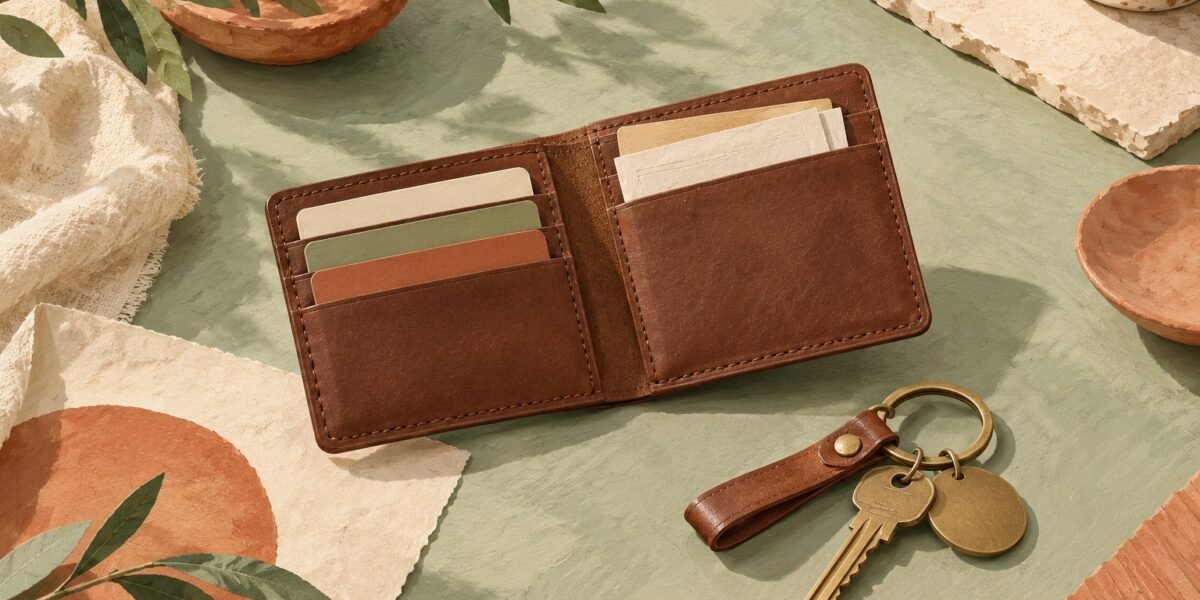
A wallet looks slim in a product photo because you cannot see what happens when it contains your everyday items. Before replacing yours, make a short inventory and decide what needs to remain accessible. The best size for your routine depends on the contents and where you carry them, not the word minimalist in a listing.
Count the contents you really need
Empty your current wallet in a private place. Separate daily-use cards, occasional cards, cash, coins, and old receipts. Decide what must stay with you and what can be stored appropriately elsewhere. Do not discard identification or documents just to reach an arbitrary card count.
Write a simple carry brief, such as six cards, a few folded bills, and no coins. This is an example rather than a recommended limit. If you routinely need coins or unfolded notes, include that requirement before looking at very small cardholders.
Choose the layout before the material
Compare a cardholder, a bifold, and a zip-around design against your inventory. Look at how each item would be inserted and retrieved. A compartment that technically holds something may still be inconvenient if it requires removing several other items first.
Check whether the listed card capacity refers to individual slots or stacked cards. Do not force more into a slot than the product is designed to hold. For online purchases, photographs showing the interior are often more useful than several views of the closed exterior.
Measure the place where it will live
Compare the closed dimensions with your usual pocket or bag compartment. Remember that exterior measurements of an empty wallet do not describe its loaded thickness. Use your current wallet as a physical reference rather than trying to judge scale from a hand in a photograph.
If you carry a small bag, check the opening as well as the pocket. Our crossbody bag guide explains why usable space can differ from exterior dimensions. Decide which item needs replacing before buying a wallet and a bag that still do not work together.
Test access with representative contents
Where permitted, use blank sample cards and paper rather than exposing personal card details during a store fitting. Load only the amount you plan to carry. Close the wallet normally, then retrieve the item you use most often and put it away again.
Check whether a snap or zipper closes without pressure and whether the shape becomes awkward in the intended pocket. Inspect the slot edges, lining, and stitching. Material names and extra feature labels are not a substitute for checking the way the wallet actually opens and closes.
Make a practical keep-or-return decision
Read the care guidance and return conditions before committing. Avoid personalization or other irreversible changes until you understand their effect on returns. If you order online, keep the packaging and perform any allowed indoor check before removing labels.
Keep the wallet if it handles your real contents without daily rearranging. Then decide where receipts will go after a purchase instead of letting them fill every spare slot. A small tray in your entryway setup can provide a temporary stop before you file or discard them appropriately.
Cover: AI-generated editorial illustration of generic items, not a photograph of a tested product.
Daniel · Daycraftly
I’m interested in technology that earns its place in your day. My focus is on useful gadgets, straightforward digital tools, and better ways to get work done. I like to look past the headline features and ask a simpler question: what problem does this solve? Expect clear comparisons, practical workflows, and ideas for making your digital life feel less complicated.
Join the conversation
Share a useful tip or ask a question. Comments are reviewed before publication. Your email address will not be displayed.


Leave a Reply