
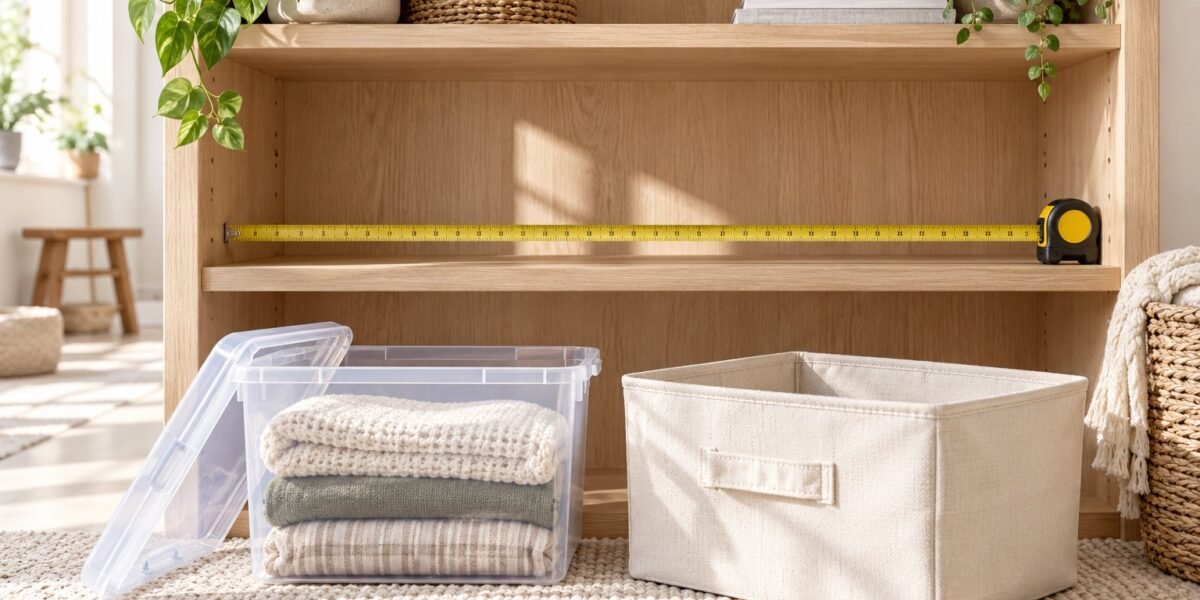
A storage box can match your room and still fail at its main job. It may fit on the shelf but not through the opening, hold less than expected, or require you to unstack three containers whenever you need one item. Start with the space and the contents before choosing a matching set.
This guide is a buying checklist, not a review of a particular brand. You can use it for a fabric bin, a clear plastic container, or a lidded box. Bring your measurements to the store or keep them beside the product listing when shopping online.
Measure the opening and the resting space
Record the usable width, depth, and height of the shelf or cupboard. Check the narrowest part of the opening, including hinges, a door frame, or a shelf lip. A container that fits inside the cupboard may still be awkward to move through its door.
Compare those measurements with the box’s external dimensions, including the lid and handles. Leave enough room to grip and remove it; there is no universal clearance that suits every design. If the product page does not make the measurements clear, ask the seller before buying.
Check what fits inside, not just the stated capacity
External dimensions and usable internal space answer different questions. Tapered sides, rounded corners, and a lid that sits inside the rim can matter when storing rigid objects. A capacity in liters does not tell you whether a particular folder or device will lie flat.
As an example of information to look for, IKEA’s SAMLA box-with-lid listing provides product measurements and capacity. Use the exact listing for the size you are considering, and confirm the interior dimensions when an item needs a precise fit. This is a specification example, not a claim that the model suits every shelf.
Decide how you will reach the contents
Picture taking out the item you use most often. Will you pull out the whole box, lift the lid while it stays on the shelf, or remove boxes stacked above it? For daily-use items, access may matter more than how neatly a stack looks.
A lid can be useful when you want contents covered, but it also becomes another piece to handle. An open bin may suit frequently used textiles or accessories. Check the manufacturer’s instructions before relying on a container for stacking or heavy loads; appearance alone does not establish what it can support.
Try a simple measuring example
Imagine a shelf opening 60 cm wide, 32 cm deep, and 28 cm high. Two boxes that are each 29 cm wide would occupy 58 cm before allowing for anything else. That leaves 2 cm in total, not 2 cm around each box. Handles or a wider lid could eliminate that gap.
Cut a piece of spare cardboard to the footprint of one candidate box and place it on the shelf. Check the height separately, then consider the lid’s movement. This rough model will not prove the product fits, but it can reveal an obvious mismatch before you place an order.
Buy one first and compare the full cost
If you need several identical boxes, consider testing one before ordering the complete set. Fill it with the actual items, put it in its intended location, and try removing it. A successful empty-box fit is not the same as comfortable everyday use.
- Check whether the lid, clips, or dividers are included or sold separately.
- Compare delivery and return costs along with the box price.
- Confirm the exact size and color before ordering additional units.
- Keep the product reference and measurements so you can find a matching replacement later.
The aim is storage that you can use without rearranging the room every time. Start with one location, one group of items, and one tested container. For belongings you carry out each day, a simple drop zone may be more useful than another closed box. Product reference checked October 2, 2026.
Emma · Daycraftly
A good deal is more than a crossed-out price. I’m all about clever finds, useful products, and checking what you actually get for your money. From AliExpress discoveries to everyday essentials, my focus is on the details behind the offer: materials, features, seller information, and return terms. Think less impulse-buy clutter and more things you’ll be glad you found.
Join the conversation
Share a useful tip or ask a question. Comments are reviewed before publication. Your email address will not be displayed.


Leave a Reply