
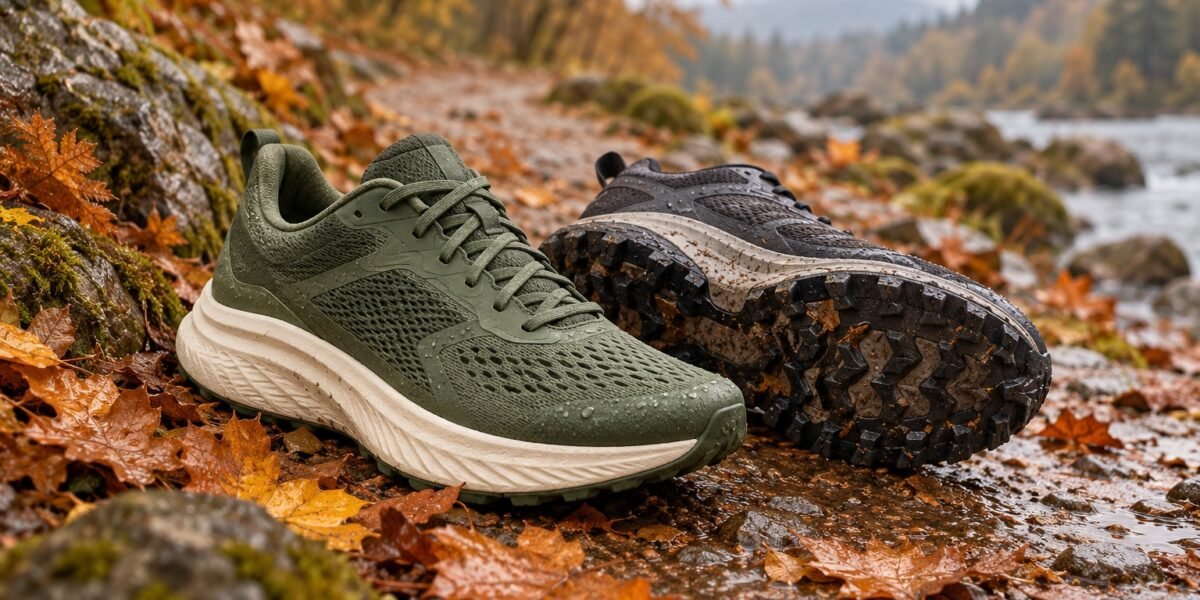
Buying running shoes for fall starts with the ground under your feet. A rainy road loop, a gravel park path, and a muddy woodland trail are different shopping problems—even when the forecast looks the same. Choose for the route you actually run, then compare weather protection, fit, and the full price.
The three models below offer a starting shortlist for those situations. They are examples to compare, not a ranking of everything on sale. Product details were checked against the manufacturers’ pages on October 1, 2026; local sizes, colors, prices, and availability can change.
This is a specifications-based buying guide, not a hands-on review. The cover is an AI-generated editorial illustration of generic shoes, not a photograph of the models below. Links go directly to manufacturers without affiliate tracking.
Start with your usual route
- Mostly pavement: start with a road-running model whose maker specifically describes wet-weather traction.
- Pavement plus park trails: compare a less technical trail model, especially if your run regularly switches surfaces.
- Soft, muddy ground: look for a model designed around that terrain rather than choosing only by cushioning thickness.
Write a one-sentence shopping brief before opening a store: “I need shoes for a 40-minute paved loop in frequent rain,” for example. Use that sentence to reject attractive discounts on shoes intended for a different job.
For wet road runs: Nike Pegasus 41 GORE-TEX
Nike positions this version of the Pegasus as a waterproof road-running shoe. Its listed construction combines a GORE-TEX upper, ReactX cushioning with Air Zoom units at the front and heel, and a Storm Tread outsole intended for wet-weather traction. See Nike’s product details.
Why put it on your shortlist: its stated purpose matches a road route where rain is a recurring concern. What to check: that the listing is specifically the GORE-TEX edition. The ordinary Pegasus and a similarly named trail version should not be treated as interchangeable products.
Try the shoe with the socks you intend to run in. Check whether your heel stays comfortably in place and whether your toes feel crowded when you move. A familiar model name is not a substitute for checking the fit of the exact version.
For a road-to-trail loop: Nike Pegasus Trail 5 GORE-TEX
The Trail 5 GORE-TEX combines a waterproof upper with ReactX foam and Nike Trail All-Terrain Compound rubber. Nike describes the outsole as providing grip on wet terrain while maintaining a smooth road ride. That makes it a candidate to compare for a route that mixes pavement and trails. See Nike’s product details.
Why put it on your shortlist: you want one pair to evaluate for a mixed route. What to check: how much of your run is actually off-road. If the trail section is only a brief shortcut, do not let its name outweigh how the shoe feels during the rest of your run.
For muddy trails: Salomon Speedcross 6 GORE-TEX
Salomon identifies mud as this model’s terrain and lists a waterproof, breathable GORE-TEX membrane. Its Mud Contagrip outsole uses deep lugs intended for soft, loose, uneven ground. Those details give you a more specific reason to consider it than a general “all-weather” label. See Salomon’s product details.
Why put it on your shortlist: soft trails and mud are central to your route. What to check: whether you actually need that terrain focus. Do not assume that a shoe described for mud is automatically the right purchase for an urban pavement route.
Keep weather claims in perspective
Waterproofing and traction answer different questions. A waterproof upper does not establish how an outsole behaves on every surface. Likewise, a maker’s wet-weather description is not a guarantee against slipping on ice or leaf-covered pavement.
This shortlist does not establish that any foam stays equally soft at every temperature. To support that claim, you would need relevant cold-condition testing of the exact model. Treat unfamiliar foam names, a carbon plate, or a large discount as details to investigate—not proof that a shoe is suitable for your fall runs.
If rain is only an occasional concern, compare the waterproof and regular versions before paying extra. Ask what problem the extra feature would solve on your normal route, and whether you prefer the fit and feel of that version.
Check these details before paying
- Confirm the exact model, GORE-TEX designation, size system, and width in the seller’s listing.
- Check the return window and whether indoor try-on is allowed. Do not assume outdoor wear can be returned.
- Compare the final price, including delivery and return costs, rather than only the advertised percentage off.
- Save the product page and order details so you can verify which version you bought.
Keep two serious candidates, try them under the seller’s return conditions, and choose the pair that matches your route and fits comfortably. If you are researching across several stores, our simple bookmark system can keep the comparison manageable.
Emma · Daycraftly
A good deal is more than a crossed-out price. I’m all about clever finds, useful products, and checking what you actually get for your money. From AliExpress discoveries to everyday essentials, my focus is on the details behind the offer: materials, features, seller information, and return terms. Think less impulse-buy clutter and more things you’ll be glad you found.
Join the conversation
Share a useful tip or ask a question. Comments are reviewed before publication. Your email address will not be displayed.



Leave a Reply